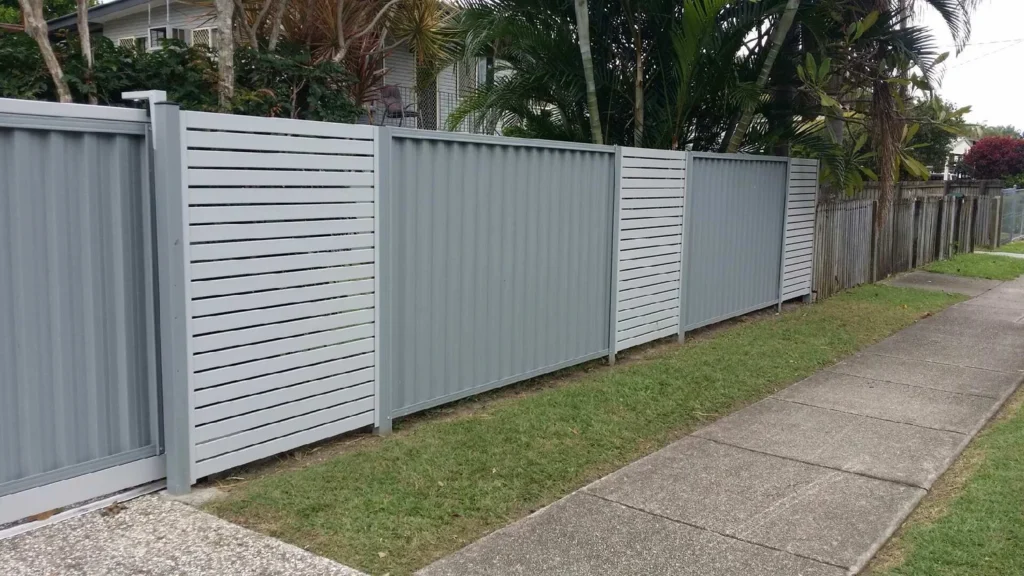
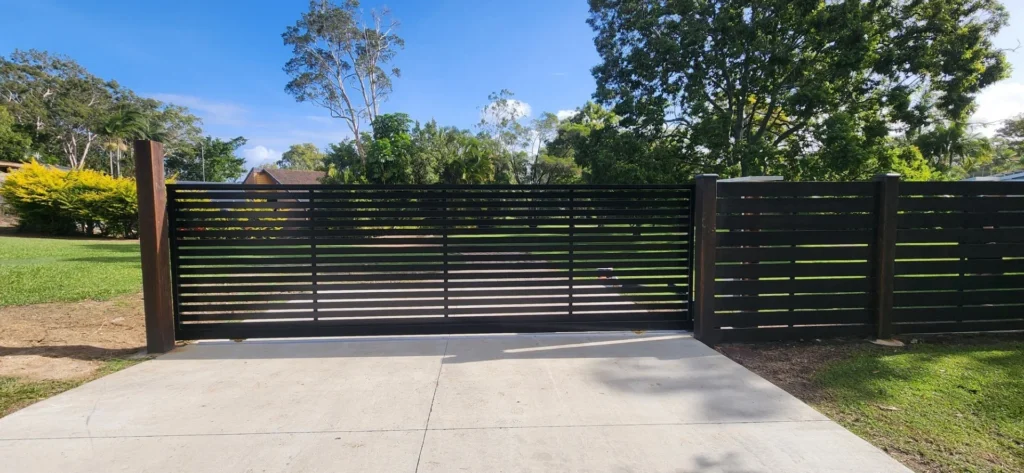
Choosing between a sliding gate and a swing gate feels like a style decision. It usually isn't. Nine times out of ten the answer is decided by your driveway before you get anywhere near colours and infill patterns, and the sooner you work that out, the less time you waste falling in love with a gate that will not fit your property.
Here is how the two compare in practice, and what actually makes the decision for most Brisbane and Moreton Bay homes.
Swing Gates: The Default, and Usually the Cheaper One
A swing gate is hinged at the post and opens in an arc, either as one leaf or as a pair that meets in the middle. It is the simpler mechanism, there is less hardware to go wrong, and for a standard suburban driveway it is normally the more affordable option.
The catch is the arc. A swing gate needs a clear, level sweep of space to open into, and that space has to stay clear. Parked cars, wheelie bins, garden beds and delivery boxes all end up in the way eventually.
A swing gate suits you if:
Your driveway is reasonably level at the gate line
You have clear space for the gate to swing into, inside or outside the boundary
The opening is a normal single or double driveway width
You want the lowest-cost option that still looks good
Sliding Gates: When Space or Slope Rules Out Swinging
A sliding gate runs sideways along the fence line, either on a bottom track or cantilevered above the ground. It needs no arc at all, which is exactly why people choose it.
What it does need is room to slide into. As a rough rule, a sliding gate wants clear run-back roughly as long as the opening itself, along the inside of your boundary. If there is a wall, a garden bed or a garage corner in that space, a sliding gate becomes awkward fast.
A sliding gate suits you if:
Your driveway slopes up or down at the gate line
You park close to the gate and cannot keep an arc clear
The opening is wide, such as a double driveway or acreage entry
You have a clear run of fence line for the gate to slide behind
The Four Things That Actually Decide It
1. Slope. This is the big one, and it is where most people get caught out. A swing gate has to clear the ground through its entire arc. If your driveway rises even moderately behind the gate, the gate will jam against the rise before it is fully open. You can sometimes fix this by hanging the gate to swing outward, but that only works if it is safe and legal to swing over the footpath, which often it is not. A sliding gate does not care about slope in the same way, because it never travels over the driveway surface.
2. Space along the fence. The mirror image of the slope problem. Sliding gates trade the swing arc for a run-back along your boundary. Measure it honestly before deciding.
3. Width. The wider the opening, the more a single swing leaf sags and the harder its hinges work. Past a certain width you are looking at a double gate or a sliding gate. For long acreage entries, sliding usually wins.
4. Wind. Worth thinking about on an exposed or coastal block. A solid, privacy-style infill turns your gate into a sail, and a wide swing gate catches far more wind load than a sliding one. If you want solid infill on a wide opening in a windy spot, sliding is the calmer choice.
Automation Changes the Maths
If you are automating now, or think you might later, it is worth deciding the gate type with that in mind. Retrofitting is possible, but it is cheaper to plan for it up front.
Sliding and swing gates use different motors. Sliding gates typically run a rack-and-pinion drive along the gate. Swing gates use ram or articulated arm motors, one per leaf, so a double swing gate needs two motors where a sliding gate needs one.
Two things matter more than brand:
The motor has to match the gate. Motors are rated by gate weight and length. A motor sized for a light aluminium gate will not last on a heavy steel one, and an underpowered motor fails early. We size the motor to the gate's weight, length and how often it will be used, rather than selling a one-size kit.
Power may decide it for you. Running mains power out to a front gate can be a significant cost on a long driveway. Solar gate motors avoid that entirely, which is why they are common on acreage and rural entries around Moreton Bay. We supply solar options for exactly this reason.
See our gate automation range for motors, remotes, keypads, safety sensors, and retrofit hardware for gates you already have.
What About Cost?
For a standard driveway on level ground, a swing gate is usually the cheaper way in: simpler hardware, and only one motor if you go with a single leaf.
Sliding gates cost more up front, but that comparison is a little unfair. People generally choose sliding because a swing gate will not work well on their block, and a cheap gate that fouls on the driveway or has to be manhandled every time is not a saving.
The honest advice: work out which type your property actually allows first, then set the budget. Not the other way around.
What We Supply
Accolade Fencing manufactures and supplies both. Sliding and swing gates, pedestrian and driveway, custom-made to match your existing fence line and colour rather than fitted to a standard size. We have been fabricating and welding gates from our Deception Bay workshop for 40 years, so if your opening is an unusual width or your fence is an odd profile, that is normal work for us.
We are a supplier and manufacturer, not an installation company. We make the gate, supply the automation to suit it, and can point you toward trusted local installers who work with our products.
Not sure which way your driveway points you? Tell us the opening width, whether it slopes, and what is behind the gate line, and we will tell you honestly which type we would put there.